Artificial Intelligence is transforming the modern workplace. From writing emails and preparing reports to analyzing information and organizing daily activities, AI offers new ways to accomplish familiar tasks.
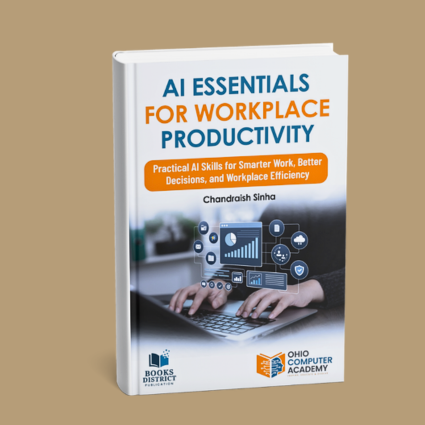
AI Essentials for Workplace Productivity is a practical guide to understanding and applying AI in everyday professional situations. Written for professionals rather than technical specialists, the book focuses on real-world applications, clear explanations, and techniques that readers can begin using immediately.
Whether you are exploring AI for the first time or looking to use it more effectively, this book provides a structured approach to developing practical AI skills.
Why I Wrote This Book
Throughout my work in technology and professional education, I have seen how new technologies create opportunities while also introducing uncertainty.
Artificial Intelligence is no exception.
There is considerable discussion about what AI can accomplish, but knowing that a technology exists is different from knowing how to use it effectively.
I wanted to write a book that would help bridge that gap.
My objective was not to explain the technical complexities behind AI systems, but to demonstrate how ordinary workplace activities can be improved through thoughtful and practical use of AI.
I also wanted to emphasize an important principle:
AI should support human thinking, not replace it. The ability to ask meaningful questions, evaluate responses, recognize limitations, and exercise judgment remains essential.
This book brings together those ideas through practical examples, exercises, and reusable techniques that readers can adapt to their own work.
What You’ll Learn
The book explores how AI can support a wide range of everyday professional activities.
What Makes This Book Practical?
Rather than presenting AI as an abstract technology, the book approaches it through familiar workplace situations.
Readers will find:
- Real-world examples illustrating common professional tasks.
- Reusable prompts that can be adapted to different situations.
- Hands-on exercises to practice and reinforce learning.
- Practical techniques for improving AI-generated responses.
- Guidance for incorporating AI into existing workflows.
- An emphasis on responsible use, verification, and human judgment.
The book also includes a library of ready-to-use workplace prompts, providing a practical reference readers can return to as their needs evolve.
Who Should Read This Book?
This book is intended for professionals who want to develop practical AI skills without needing a programming or technical background.
It may be particularly useful for business professionals, managers, team leaders, administrative staff, educators, entrepreneurs, and anyone whose work involves communication, information, planning, analysis, or decision-making.
No prior experience with AI is required.
A Final Thought
Learning to use AI is not simply about becoming familiar with another software tool. It is about understanding where technology can add value, recognizing where it cannot, and developing the judgment to use it effectively.
My hope is that this book helps readers move beyond experimenting with AI and begin applying it with greater confidence, purpose, and responsibility.
AI can help us work more efficiently, but the quality of our work still depends on the questions we ask, the decisions we make, and the judgment we bring to the process.