Organizations collect enormous amounts of data, but turning that information into meaningful insights remains a challenge.
Business intelligence tools help organizations organize, analyze, and visualize information so that decision-makers can better understand business performance and identify opportunities.
QlikView provides a platform for developing business intelligence applications that combine data integration, modeling, analysis, and interactive visualization.
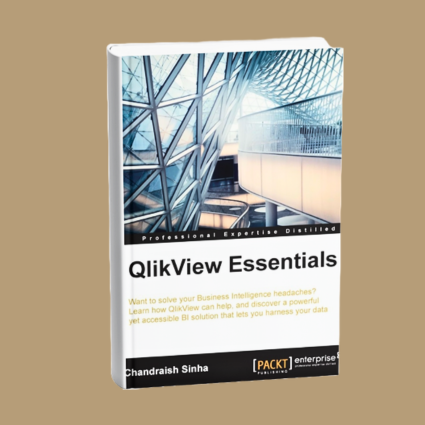
QlikView Essentials, published by Packt Publishing, is a practical guide designed to help readers understand the complete process of developing business intelligence applications using QlikView.
The book begins with fundamental QlikView concepts and progressively introduces data loading, data modeling, Extract, Transform, and Load (ETL) techniques, QVD files, mapping tables, master calendars, visualizations, and dashboard development.
It also explores application security, deployment, and best practices for integrating QlikView into an organizational environment.
Rather than focusing only on individual features, the book demonstrates how different QlikView components work together to create effective business intelligence solutions.
Whether you are new to QlikView or already familiar with its basic capabilities, this book provides a structured approach to developing practical analytical applications.
Why I Wrote This Book
Throughout my experience in technology education and business intelligence, I have observed that organizations often face a common challenge: they have access to large amounts of data but struggle to transform it into information that supports business decisions.
Creating a chart or dashboard is only one part of solving this problem.
A successful business intelligence application requires an understanding of how data is collected, loaded, transformed, modeled, analyzed, and presented.
These activities are closely connected.
For example, the way data is structured can directly influence the accuracy and usefulness of the resulting analysis. Similarly, a well-designed visualization is most effective when it is supported by a reliable data model.
I wanted to create a book that would bring these concepts together and demonstrate how they contribute to developing a complete QlikView application.
My objective was to help readers understand the entire development process rather than learn individual features in isolation.
I also wanted to address practical data modeling challenges, including working with QVD files, mapping tables, and master calendars, because these concepts play an important role in building useful analytical applications.
Beyond development, I wanted readers to understand the importance of application security and deployment.
That is why the book follows the QlikView workflow from loading data through developing dashboards and preparing applications for use within an organization.
My goal was to provide a practical resource that helps readers develop the knowledge and confidence to apply QlikView to business intelligence challenges.
What You’ll Learn
The book follows the QlikView application development process, beginning with foundational concepts and progressing through data integration, modeling, visualization, and deployment.
What Makes This Book Practical?
The distinguishing feature of QlikView Essentials is its emphasis on the complete business intelligence development process.
Rather than treating data integration, modeling, visualization, and deployment as separate subjects, the book demonstrates how these activities contribute to developing a functional analytical application.
Readers will find:
- A structured introduction to QlikView and its business intelligence capabilities.
- Guidance on loading data from different sources.
- Explanations of QVD files and their use in data handling.
- Coverage of ETL and data transformation techniques.
- Practical approaches to designing and optimizing data models.
- Solutions to common data modeling challenges.
- Guidance on using mapping tables and creating master calendars.
- Techniques for developing effective data visualizations.
- Best practices for designing interactive, user-friendly dashboards.
- Considerations for securing QlikView applications.
- Guidance on application deployment and organizational integration.
The book’s practical approach helps readers understand how individual QlikView capabilities contribute to developing complete business intelligence solutions.
From Data to Insights: Understanding the Complete QlikView Workflow
One of the central themes of QlikView Essentials is that effective business intelligence requires more than creating visualizations.
The process begins with data.
Information must be loaded from appropriate sources, transformed into useful structures, and organized through effective data modeling.
Once the data is prepared, analytical applications can be developed to help users explore information and identify meaningful patterns.
Visualizations and dashboards provide the interface through which users interact with that information.
However, a business intelligence solution is not complete until the application can be securely deployed and made available to its intended users.
This book connects these stages to help readers understand the broader process of developing and implementing QlikView applications.
By exploring the relationship between data preparation, modeling, analysis, visualization, and deployment, readers can develop a more complete perspective on business intelligence development.
Who Should Read This Book?
QlikView Essentials is intended for readers who want to understand and develop business intelligence applications using QlikView.
It may be particularly useful for:
- Beginners who want a structured introduction to QlikView.
- Business intelligence developers interested in QlikView application development.
- Data analysts who want to strengthen their data modeling and visualization skills.
- IT professionals exploring business intelligence platforms.
- QlikView users who want to move beyond fundamental features.
- Business professionals interested in using data for analytical decision-making.
- Developers seeking to understand QVD files, mapping tables, and master calendars.
- Professionals involved in implementing analytical applications within organizations.
The book is suitable for readers who have some familiarity with QlikView as well as those who want to build their knowledge from the fundamentals.
Version note: QlikView has evolved since this book was published. Readers using newer versions should consult current Qlik documentation for changes in software features, interfaces, and deployment procedures.
A Final Thought
Business intelligence is not simply about collecting data or creating attractive dashboards.
Its real purpose is to help organizations understand information and use that understanding to make better decisions.
Achieving this requires a combination of technical knowledge, analytical thinking, and an appreciation of how different components of a business intelligence solution work together.
Data modeling provides the foundation, while visualizations and dashboards make information accessible and meaningful.
Security and deployment ensure that analytical applications can be used effectively within an organization.
My hope is that this book helps readers develop that broader understanding and encourages them to approach QlikView application development as a complete process.
The value of business intelligence lies not in the amount of data an organization possesses, but in its ability to transform that data into useful insights.