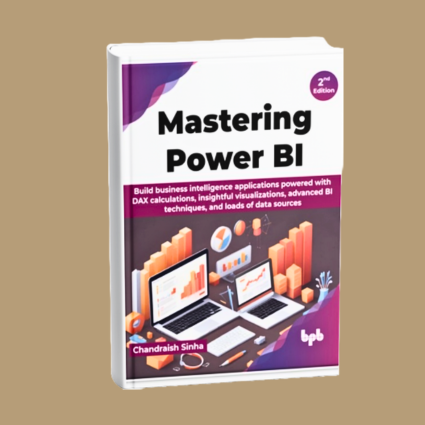
Organizations generate and collect enormous amounts of data, but the real challenge lies in transforming that information into insights that support business decisions.
Microsoft Power BI provides a powerful platform for connecting to data, preparing and modeling information, performing calculations, and creating interactive reports and dashboards.
Mastering Power BI – 2nd Edition, published by BPB Publications, is a comprehensive, hands-on guide that takes readers through the complete process of developing business intelligence applications using Power BI.
The book begins with fundamental business intelligence concepts and progressively introduces data connections, transformations, modeling, DAX calculations, visualizations, artificial intelligence capabilities, and application security.
Through step-by-step exercises and a practical project that simulates a real business environment, readers gain experience in applying Power BI concepts to complete analytical solutions.
Whether you are beginning your journey in business intelligence or looking to strengthen your Power BI development skills, this book provides a structured approach to building effective data-driven applications.
Why I Wrote This Book
Throughout my work in technology education and business intelligence training, I have observed that learning individual features of an analytical tool is only one part of developing a complete solution.
A person may know how to create a visualization or write a calculation, but building an effective business intelligence application requires a broader understanding of how data is connected, transformed, modeled, analyzed, and presented.
These activities are closely related. Decisions made during data preparation and modeling can directly influence the accuracy, performance, and usefulness of the final reports.
I wanted to write a book that would bring these concepts together rather than treat them as separate topics.
My objective was to help readers understand the complete Power BI development process, beginning with business intelligence fundamentals and progressing through data modeling, DAX calculations, visualizations, and security.
I also wanted to demonstrate how these concepts work together in practical situations.
That is why the book includes step-by-step exercises and a project that simulates a realistic business environment, allowing readers to experience how different Power BI components contribute to a complete solution.
With the second edition, the opportunity arose to expand the material to include additional capabilities, such as advanced data transformations, data profiling, custom hierarchies, and artificial intelligence visuals. My goal was to provide a resource that helps readers move beyond creating individual reports and develop a deeper understanding of how business intelligence applications are designed and implemented.
What You’ll Learn
What Makes This Book Practical?
The central approach of Mastering Power BI is to combine technical understanding with practical implementation.
Rather than presenting Power BI as a collection of independent features, the book demonstrates how its components work together to support complete business intelligence solutions.
Readers will find:
- Step-by-step exercises covering fundamental and advanced Power BI concepts.
- Comprehensive guidance on connecting, loading, and transforming data.
- Practical explanations of data modeling, relationships, facts, and dimensions.
- Detailed coverage of DAX calculations and analytical techniques.
- Guidance on designing visualizations, interactive reports, and dashboards.
- Coverage of drill-down and drill-through reporting capabilities.
- An introduction to artificial intelligence visuals within Power BI.
- Explanations of Power BI Service and application security.
- A practical project simulating a real business environment, connecting concepts across the development process.
The project-based approach is particularly valuable because it helps readers understand how individual Power BI techniques contribute to the design and implementation of a complete analytical solution.
What’s New in the Second Edition?
The second edition builds upon the foundational business intelligence and Power BI concepts covered in the original book while expanding its treatment of additional features and analytical capabilities.
Notable additions and enhancements include:
- Advanced data transformation techniques.
- Data profiling capabilities.
- Custom hierarchies for improved data exploration.
- Artificial intelligence visuals and analytical features.
- Expanded coverage of Power BI development concepts and techniques.
These additions help readers explore a broader range of capabilities while retaining the book’s emphasis on structured, hands-on learning.
Who Should Read This Book?
Mastering Power BI – 2nd Edition is intended for readers who want to develop practical skills in business intelligence, data analysis, and Power BI application development.
It may be particularly useful for:
- Aspiring Power BI developers seeking a structured learning resource.
- Business intelligence analysts who want to strengthen their technical skills.
- Data analysts interested in developing interactive reports and dashboards.
- IT professionals looking to expand their knowledge of Microsoft Power BI.
- Business professionals who work with data and analytical reporting.
- Students preparing for careers in data analytics and business intelligence.
- Professionals who want to understand the complete process of developing Power BI solutions.
The book covers foundational concepts, although familiarity with Microsoft Excel and basic database concepts is recommended.
A Final Thought
An effective business intelligence solution is not defined simply by the number of visualizations it contains or the complexity of its calculations.
Its value comes from how reliably it transforms data into information that people can understand, explore, and use to make decisions.
Achieving that requires more than technical knowledge of a single feature. It requires an understanding of how data preparation, modeling, calculations, visualization, and security work together.