Data visualization has become an essential part of how organizations analyze information, identify patterns, and communicate insights. As businesses increasingly rely on data to support decisions, professionals who can transform raw information into meaningful visualizations have valuable skills to offer.
However, learning a data visualization tool and preparing for a career that requires those skills are not necessarily the same thing.
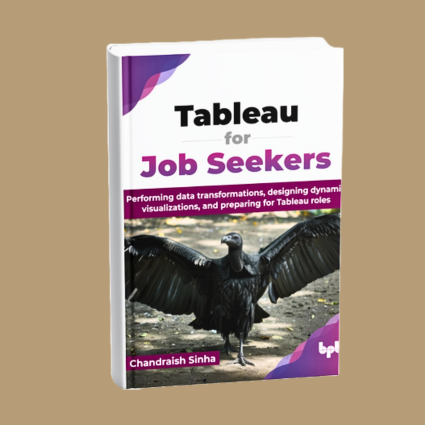
Tableau for Job Seekers, published by BPB Publications, brings these two objectives together.
The book provides a structured introduction to Tableau, progressing from fundamental concepts to advanced analytical techniques, while also exploring career opportunities, practical applications, and interview preparation.
Whether you are beginning your career in data analytics, transitioning from another field, or strengthening your existing business intelligence skills, this book offers a practical approach to developing Tableau knowledge with professional opportunities in mind.
Why I Wrote This Book
Throughout my work in technology education, I have interacted with individuals who are interested in careers in data analytics and business intelligence.
One challenge I have observed is that learning a technology does not automatically prepare someone to use it in a professional environment or demonstrate their abilities during the hiring process.
A person may know how to create charts in Tableau but still struggle to explain data relationships, select appropriate calculations, design an effective dashboard, or discuss how their work could address a business problem.
At the same time, many aspiring professionals are uncertain about which Tableau skills employers value and how to prepare for roles that involve data visualization.
These considerations shaped my approach to this book.
I wanted to bring together two important aspects of professional development: learning Tableau as a technology and understanding how that knowledge relates to career opportunities.
My objective was to provide readers with a structured learning path that develops their technical understanding while encouraging them to think about practical applications, professional expectations, and interview preparation.
The book therefore goes beyond explaining Tableau features. It explores the role of Tableau in business, the skills associated with data-focused careers, and ways to prepare for professional opportunities.
Ultimately, I wanted readers to develop not only the ability to work with Tableau but also the confidence to demonstrate and communicate those skills.
What You’ll Learn
The book takes readers through Tableau concepts, practical analytical techniques, and career preparation topics.
What Makes This Book Practical?
The distinguishing feature of Tableau for Job Seekers is its focus on connecting technical learning with professional readiness.
Rather than concentrating exclusively on how to operate Tableau, the book places technical concepts within the broader context of business applications and career development.
Readers will find:
- A structured progression from Tableau fundamentals to advanced analytical techniques.
- Coverage of data connections, preparation, transformation, and merging.
- Explanations of calculations, LOD expressions, and analytical features.
- Guidance on developing meaningful visualizations, dashboards, and data stories.
- Discussion of Tableau’s role in business intelligence and the job market.
- Career-oriented content addressing Tableau-related professional opportunities.
- Interview preparation and guidance on developing an online professional profile.
- A combination of technical knowledge and career-focused learning.
The objective is to help readers understand not only how Tableau works but also how their knowledge can be applied and communicated in a professional setting.
Who Should Read This Book?
Tableau for Job Seekers is intended for individuals who want to develop Tableau skills and understand how those skills relate to professional opportunities.
It may be particularly useful for:
- Aspiring data analysts preparing for entry-level roles.
- Students exploring careers in data analytics and business intelligence.
- Professionals considering a career transition into data-related fields.
- Business analysts seeking to strengthen their visualization capabilities.
- IT professionals looking to expand their Tableau knowledge.
- Individuals preparing for Tableau-related interviews.
- Professionals who want to improve their ability to analyze and communicate data.
A basic understanding of data concepts can be helpful, but readers do not need extensive prior experience with Tableau.No prior Tableau experience is required. Basic familiarity with Microsoft Excel can be helpful.
A Final Thought
Developing technical skills is an important part of preparing for a career in technology, but technical knowledge alone is not always enough.
Employers are interested in how effectively individuals can apply what they know, solve problems, interpret information, and communicate their findings.
In data visualization, this means understanding not only how to create a chart or dashboard but also why a particular approach is appropriate and what insights it provides.
My hope is that this book helps readers develop that broader perspective, connecting Tableau knowledge with the practical expectations of professional roles.
Learning a technology helps you develop a skill. Understanding how to apply and demonstrate that skill helps you build a career.