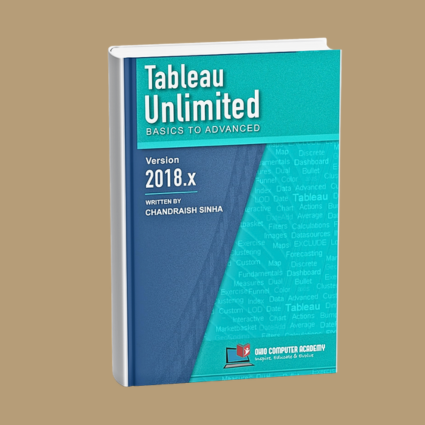
Tableau is a powerful data visualization and analytics platform that enables users to explore information, identify patterns, and communicate insights through interactive charts, dashboards, and stories.
Tableau Unlimited: Basics to Advanced is a comprehensive, hands-on guide designed to help readers develop practical Tableau skills, beginning with fundamental concepts and progressing to advanced analytical techniques.
The book includes 50+ step-by-step exercises using 10 different data sources, allowing readers to practice concepts and develop confidence in applying Tableau to real-world analytical problems.
Beginning with data preparation and fundamental visualizations, the book progressively introduces date calculations, advanced table calculations, Level of Detail (LOD) expressions, parameters, mapping techniques, and sophisticated visualizations.
Readers also learn how to create interactive dashboards and stories that communicate analytical findings effectively.
The book was developed around Tableau 2018.3 and includes features introduced in versions 2018.2 and 2018.3. Many foundational concepts remain applicable to newer Tableau versions, although certain features and interface elements may differ.
Whether you are beginning your journey in data analytics or looking to strengthen your Tableau skills, this book provides a structured approach to learning through practical experience.
Why I Wrote This Book
Throughout my experience in technology education and data analytics training, I have observed that learning a visualization tool requires more than understanding its individual features.
A person may know how to create a bar chart or connect to a data source, but effective data analysis involves understanding the data, choosing appropriate calculations, identifying meaningful patterns, and presenting information in a way that supports decision-making.
Tableau makes it possible to explore data visually, but developing proficiency requires practice across different analytical situations.
I wanted to create a book that would help readers progress from basic concepts to advanced Tableau techniques through a structured, hands-on approach.
My objective was to make Tableau accessible to beginners while providing enough depth for readers who wanted to explore more sophisticated analytical capabilities.
That is why I included more than 50 exercises using 10 data sources. Rather than simply describing features, the book encourages readers to work through examples and understand how different Tableau techniques can be applied.
I also wanted to demonstrate that advanced visualizations and calculations are not necessarily beyond the reach of beginners. With clear explanations and step-by-step practice, readers can gradually develop the confidence to work with increasingly complex analytical problems.
The result is a book designed to support learning through exploration, experimentation, and practical application.
What You’ll Learn
The book takes readers through Tableau’s fundamental and advanced capabilities, covering data preparation, calculations, visualizations, mapping, and dashboard development.
What Makes This Book Practical?
The central approach of Tableau Unlimited: Basics to Advanced is to combine conceptual understanding with extensive hands-on practice.
Rather than presenting Tableau as a collection of independent features, the book provides exercises that allow readers to apply different techniques and understand their practical uses.
Readers will find:
- More than 50 step-by-step exercises covering basic and advanced Tableau concepts.
- Practice using 10 different data sources.
- Guidance on preparing and formatting data for analysis.
- Coverage of date calculations, advanced table calculations, and LOD expressions.
- Practical exercises involving a wide range of advanced visualizations.
- Techniques for creating interactive analytical experiences using parameters and custom shapes.
- Advanced geographic and spatial mapping exercises.
- Guidance on developing dashboards and Tableau Stories.
- Coverage of features introduced in Tableau 2018.2 and 2018.3.
The exercise-based approach is particularly valuable because it allows readers to develop their understanding through direct interaction with data rather than relying solely on theoretical explanations.
Advanced Tableau Capabilities Covered
One of the distinguishing features of this book is its extensive coverage of advanced Tableau techniques.
Beyond fundamental data visualization concepts, readers explore analytical methods that can help answer more complex business questions.
These include advanced table calculations, nested LOD expressions, market basket analysis, clustering, and specialized chart types.
The book also introduces advanced mapping techniques, including spatial data connections, custom polygons, and external mapping services.
Together, these topics help readers expand their Tableau knowledge beyond basic reporting and explore more sophisticated approaches to data analysis and visualization.
Who Should Read This Book?
Tableau Unlimited: Basics to Advanced is intended for readers who want to develop practical skills in data visualization and analytics.
It may be particularly useful for:
- Beginners who want to learn Tableau through structured exercises.
- Students preparing for careers in data analytics and business intelligence.
- Data analysts seeking to strengthen their visualization and calculation skills.
- Business professionals who work with reports, dashboards, and analytical information.
- IT professionals interested in expanding their data analytics capabilities.
- Tableau users who want to explore advanced calculations, visualizations, and mapping techniques.
- Professionals who prefer learning through practical exercises rather than theoretical explanations alone.
No extensive background in databases or SQL is required.
A basic understanding of computer systems and Microsoft Excel is sufficient to begin working through the material.
The book was written for Tableau 2018.3, with many concepts also applicable to Tableau 10.x and subsequent versions. Readers using current releases should expect some differences in interface design and functionality. do not need extensive prior experience with Tableau.No prior Tableau experience is required. Basic familiarity with Microsoft Excel can be helpful.
A Final Thought
Data visualization is not simply about creating attractive charts. Its real value comes from helping people understand information, recognize patterns, and make informed decisions.
A visualization becomes meaningful when it communicates something that might otherwise remain hidden within rows and columns of data.
Developing that ability requires both technical knowledge and analytical thinking.
My hope is that this book helps readers develop those skills through practical experience, giving them the confidence to explore data, experiment with different techniques, and create visualizations that communicate meaningful insights.
The purpose of data visualization is not merely to display information, but to make information understandable and useful.